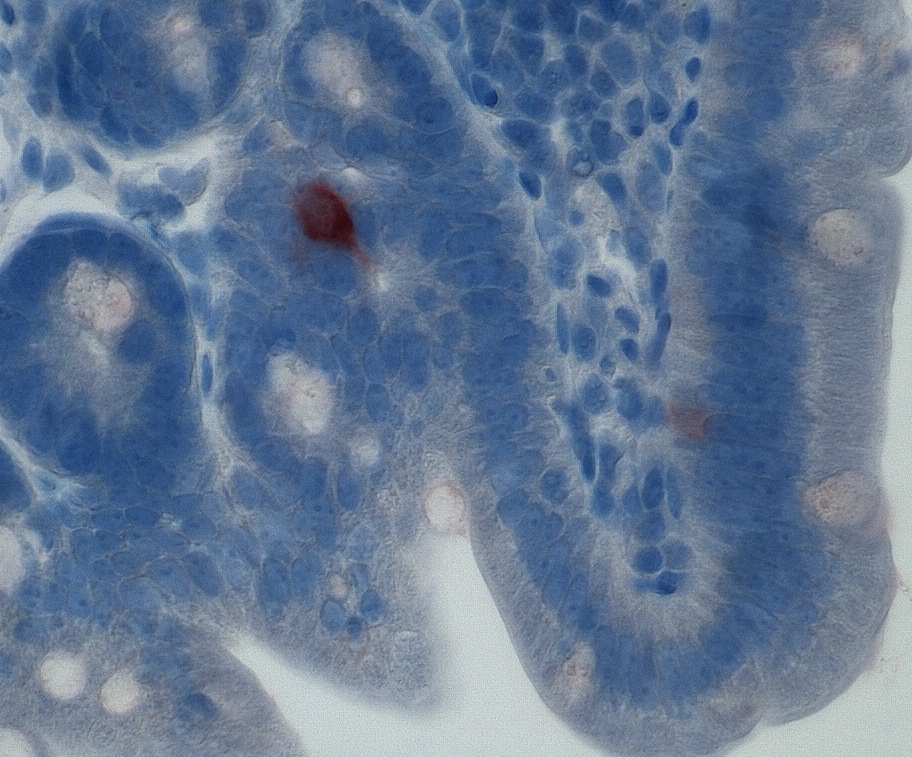
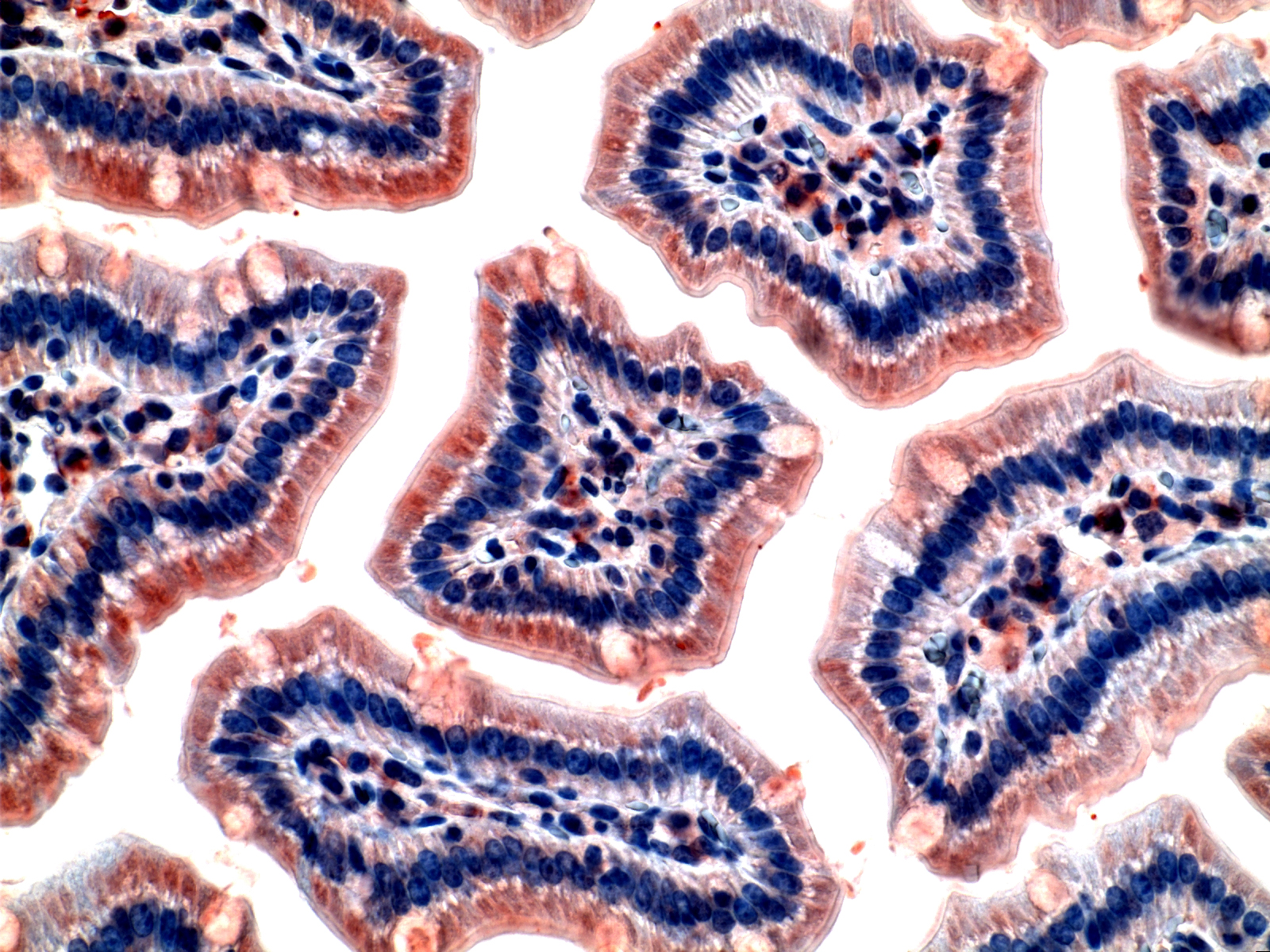
Image of mouse intestinal cells after colonization with V. cholerae, pre-treated with
commensal bacteria (L) or commensal bacteria expressing a V. cholerae quorum signal (R).
Red staining indicates the presence of cholera toxin.
|
NEWS
Chris Aurand and Matt Russell publish "Synthetic signaling networks for therapeutic applications" in Current Opinion in Biotechnology!
Jay Sung and
Jiajie Yu's paper
on in vitro intestinal models is published in Lab on a Chip (Link).
Nice work!!
Houchun Liu
joins the lab. Welcome Houchun!!
Faping
Duan's
paper gets mentioned in Science
Signaling as an editor's choice:
http://stke.sciencemag.org/cgi/content/abstract/sigtrans;3/128/ec193
...and again in ASM's Microbe:
http://www.microbemagazine.org/index.php/10-2010-current-topics/2840-minitopics
Way to go, Faping!!
March gets an NIH New Innovator award...
http://nihroadmap.nih.gov/newinnovator/recipients10.asp
Matt Russell's paper, "Bootstrap estimation of
confidence intervals on mutation rate ratios." has been accepted to
Enviromental and Molecular Mutagenesis. Congrats, Matt!!
|
| This research involves the development of modular
expression cassettes that will re-configure target organisms for safe
and effective therapeutic synthesis within a mammalian host. We are
engineering enteric bacteria into effective in vivo cellular factories,
responding to a specific molecular imbalance by synthesizing an
appropriate corrective therapeutic. Cellular therapies share a need for
accurate detection of target molecule levels, benign coexistence within
the host, and a sufficient level of tunable gene expression. |
We are developing platforms to simultaneously screen
several species of microorganism for their ability to convert
recalcitrant compounds into benign and, where possible, value-added
products. Taking advantage of the Cornell Nanofabrication Facility and
working with collaborators with expertise in material science we are
developing several microfluidic reactor formats for studying how
species communicate with one another and with their environments.
Examples include microfluidic chemostats for studying bacterial
signaling in series and "gut tube reactors" for mimicking the upper GI
tract. These reactors are being specifically designed to extract
information that is normally not possible in traditional cell culture
formats. In the long term we are looking to improve in vitro models to
the point that they are more accurate and reliable than competing in
vivo models for understanding signaling interactions. |
Microorganisms have several mechanisms for sensing and
responding to their environments. We want to learn more about these
mechanisms (such as promoters, enhancers, and inhibitors), and
incorporate them into biotechnological solutions to a wide variety of
problems. By using tunable gene silencing via RNA interference (RNAi),
short RNAs (sRNA), or micro RNA, we can study the dynamics of signaling
cascades that are controlled by sensing mechanisms. From here we use
cell signaling and tunable gene expression to correct and enhance
target organisms so they can more effectively adapt to environments
that we define. |